Try the live demo
No install needed
- User
- admin
- Password
- demoAdmin123
- POS PIN
- 1234
Demo data refreshes nightly to keep the sample company clean.
Open live demoA valid tax invoice is the evidence behind every input VAT claim and the document that fixes your output tax period. This checklist covers the 14-day rule, the fields on a standard invoice, simplified invoices, credit notes and the one check you should do on every template.
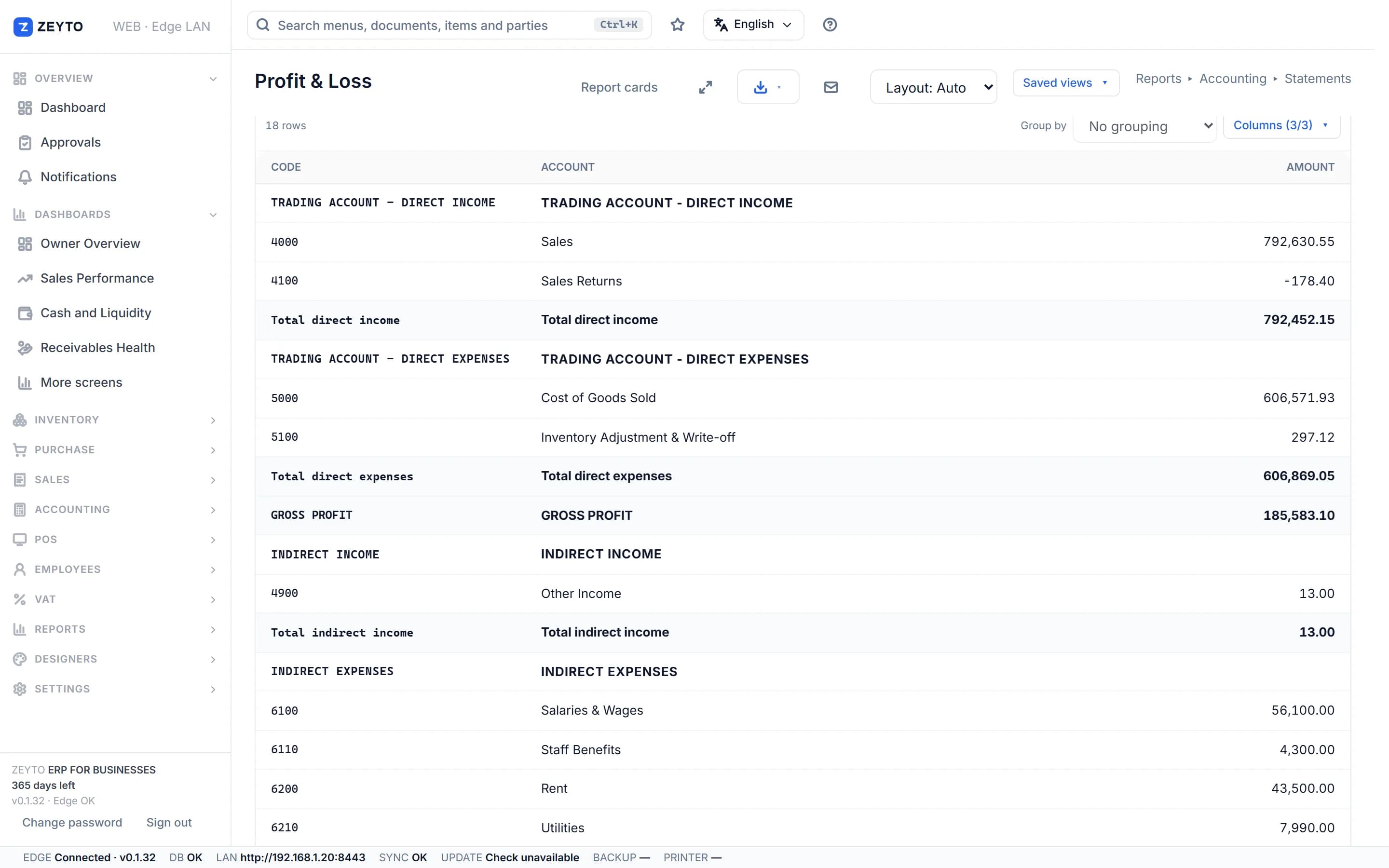
Screenshot from the Zeyto demo company, with sample data.
Why it matters
A tax invoice is the document that records a taxable supply. UAE VAT law (Federal Decree-Law No. 8 of 2017, Article 67) says it must be issued within 14 days of the date of supply. For the supplier it fixes the date of supply and therefore the tax period in which the output tax belongs. For the buyer it is the evidence behind an input VAT claim, and the FTA's tax invoice guide calls a valid tax invoice the primary documentary evidence for recovering VAT.
That is why a missing TRN or an unnumbered invoice is not a cosmetic problem. A customer who cannot support their input VAT claim with a valid tax invoice may refuse to pay the VAT, or ask you to reissue the document. Getting the template right once saves a correction every month.
Standard tax invoice
Based on the FTA guidance summarised in the Zeyto Academy. Confirm the current rules on the FTA website.
Simplified invoices
Under the VAT rules as the FTA published them before the e-invoicing reform, a simplified tax invoice is allowed when the buyer is not VAT-registered, or when the buyer is registered and the VAT-inclusive consideration is AED 10,000 or less. It needs only the words "tax invoice" prominently, the supplier's name, address and TRN, the date of issue, a description enough to identify the goods or services, and the total consideration and VAT charged. Retail receipts are the usual example.
Cabinet Decision No. 100 of 2025 amended Articles 59 and 60 of the VAT Executive Regulation for the e-invoicing reform, and advisers report that the simplified invoice option ends for businesses once they are brought into the e-invoicing system. The Ministry of Finance timetable runs from a pilot on 1 July 2026 to mandatory use from 1 January 2027 for businesses with annual revenue of AED 50 million or more, and from 1 July 2027 for the rest. Until your business is onboarded, check with the FTA and the Ministry of Finance which invoice rules apply to you.
Corrections
In Zeyto
Check a printed sample before you rely on it Do not assume a printout is valid because software produced it. Print your standard invoice template and check it against the list above: both TRNs, the date of supply when it differs, the invoice number, and for foreign-currency invoices the VAT amount in AED with the rate used. Zeyto's template designer lets you adjust a template. For UAE e-invoicing, Zeyto's connection to an Accredited Service Provider is not released yet, so we do not claim e-invoicing readiness. Rules change, so check the FTA website before you file. This page is general information, not tax or legal advice, and was last reviewed on 8 November 2026.
Go deeper
Go from the document to the return.
Next step
Open the public demo, install the Windows trial, or talk to the Zeyto team about your workflow.
No install needed
Demo data refreshes nightly to keep the sample company clean.
Open live demoYour own PC
Run Zeyto cloud, private cloud, on-premise or on a local server, with desktop shell, browser access and the mobile app.
Sales, support, partners
Send your industry, branch count, users and reporting needs. We route you to the right person.
FAQ
Open the demo, post an invoice and print it to check every field.