Try the live demo
No install needed
- User
- admin
- Password
- demoAdmin123
- POS PIN
- 1234
Demo data refreshes nightly to keep the sample company clean.
Open live demoSix countries, six currencies, four different tax positions. This guide explains why the Omani rial and the Kuwaiti and Bahraini dinars need three decimals, how rounding works when a document and the ledger use different currencies, and which GCC countries have VAT.
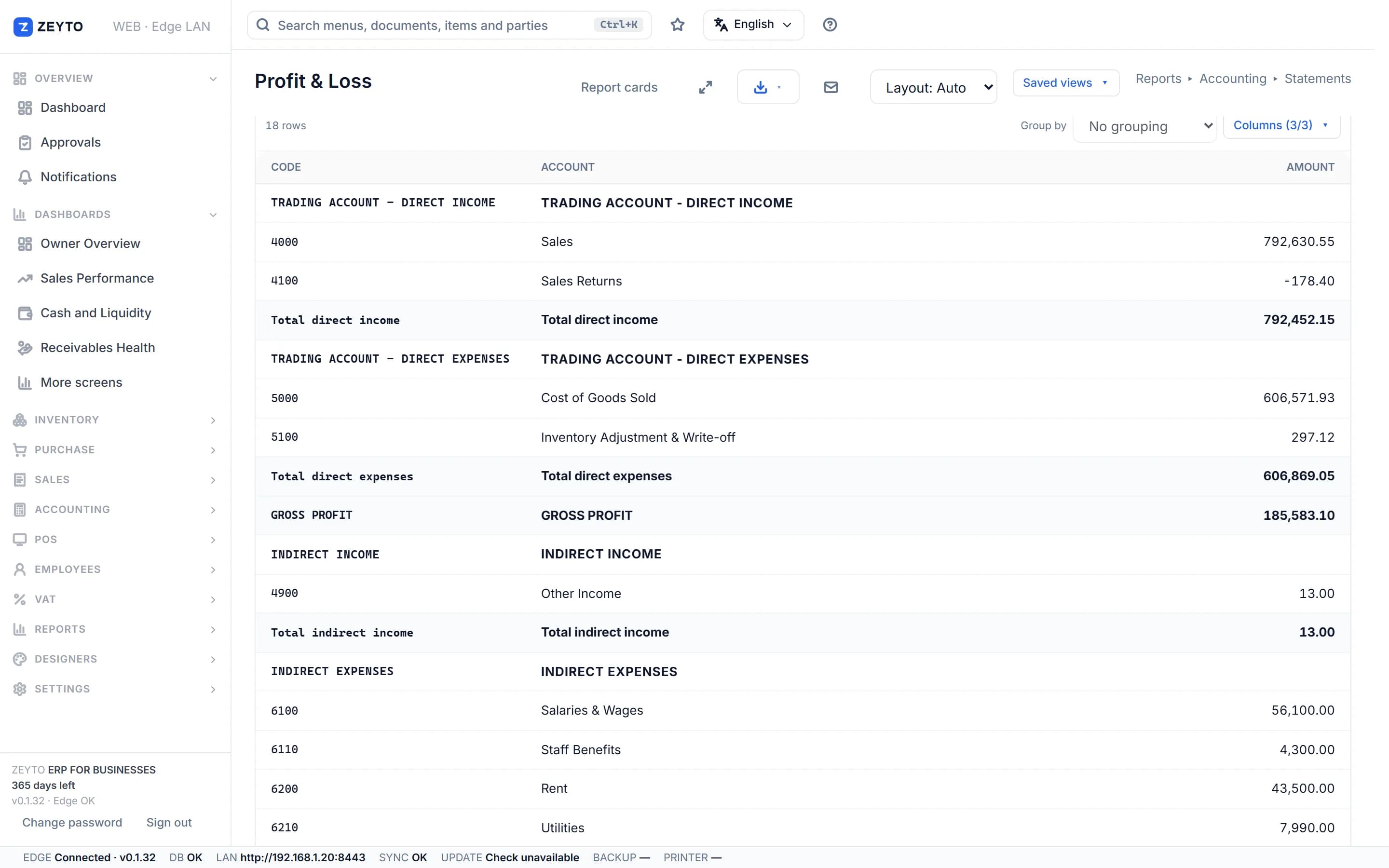
Screenshot from the Zeyto demo company, with sample data.
Subunits
Most currencies divide into 100 subunits. Three GCC currencies divide into 1,000.
Rounding
In Zeyto each currency has a subunit ratio (100, 1000, 10 or 1) and decimals (0 to 3), and the decimals must match the ratio. This is real precision, not appearance: invoice lines and VAT in the currency are rounded to that many places on documents you post from now on, and posted amounts never change.
The document face rounds to the document currency's decimals and the books round to the base currency's decimals. They are independent. A Dubai company invoicing a Kuwaiti customer in KWD writes the invoice at 3 decimals and the ledger at 2. A Kuwait City company writes both at 3. Rounding is half-up, applied after the multiplication. For example, an invoice of KWD 1,250.500 at an assumed rate of 11.9500 AED per KWD gives 14,943.475, which rounds half-up to AED 14,943.48. The customer sees KWD 1,250.500 and the ledger holds AED 14,943.48. These rates are for practice only; always use the current rate.
Tax by country
Standard rates as published by each tax authority. Rates can change, so check the local authority before relying on a figure. Reviewed 8 November 2026.
In practice
In a VAT country every taxable sale carries output VAT, every purchase carries recoverable input VAT, and the difference is settled with the tax authority each period. In a no-VAT country, invoices carry no tax line and there is no VAT account movement: sales, purchases and stock work exactly as before, with totals equal to net amounts.
Goods sold for 1,000 net show a total of AED 1,050 in the UAE (VAT 50), a total of BHD 1,100.000 in Bahrain (VAT 100.000) and a total of KWD 1,000.000 in Kuwait with no VAT line. A VAT code with a different rate does not make a Zeyto return valid for another country, because the VAT return, Corporate Tax and e-invoicing screens follow UAE rules. File non-UAE returns in the format your authority requires.
Before you start
Country demos are separate installations The live demos for the GCC markets each run on their own database. Qatar, Oman, Kuwait and Bahrain currently run the global build configured for that market, and Saudi Arabia has a dedicated edition. See the demos page to open the market you need. This page is general information, not tax or legal advice, and was last reviewed on 8 November 2026.
Go deeper
Lessons and market pages.
Next step
Open the public demo, install the Windows trial, or talk to the Zeyto team about your workflow.
No install needed
Demo data refreshes nightly to keep the sample company clean.
Open live demoYour own PC
Run Zeyto cloud, private cloud, on-premise or on a local server, with desktop shell, browser access and the mobile app.
Sales, support, partners
Send your industry, branch count, users and reporting needs. We route you to the right person.
FAQ
Each GCC demo has its own currency and database.