Try the live demo
No install needed
- User
- admin
- Password
- demoAdmin123
- POS PIN
- 1234
Demo data refreshes nightly to keep the sample company clean.
Open live demoA contractor's cash arrives late: a certified bill, minus retention, minus advance recovery, plus VAT on only part of it. This guide works the numbers and shows how Zeyto Construction & Contracting holds retention in its own ledger and releases it with two approvals.
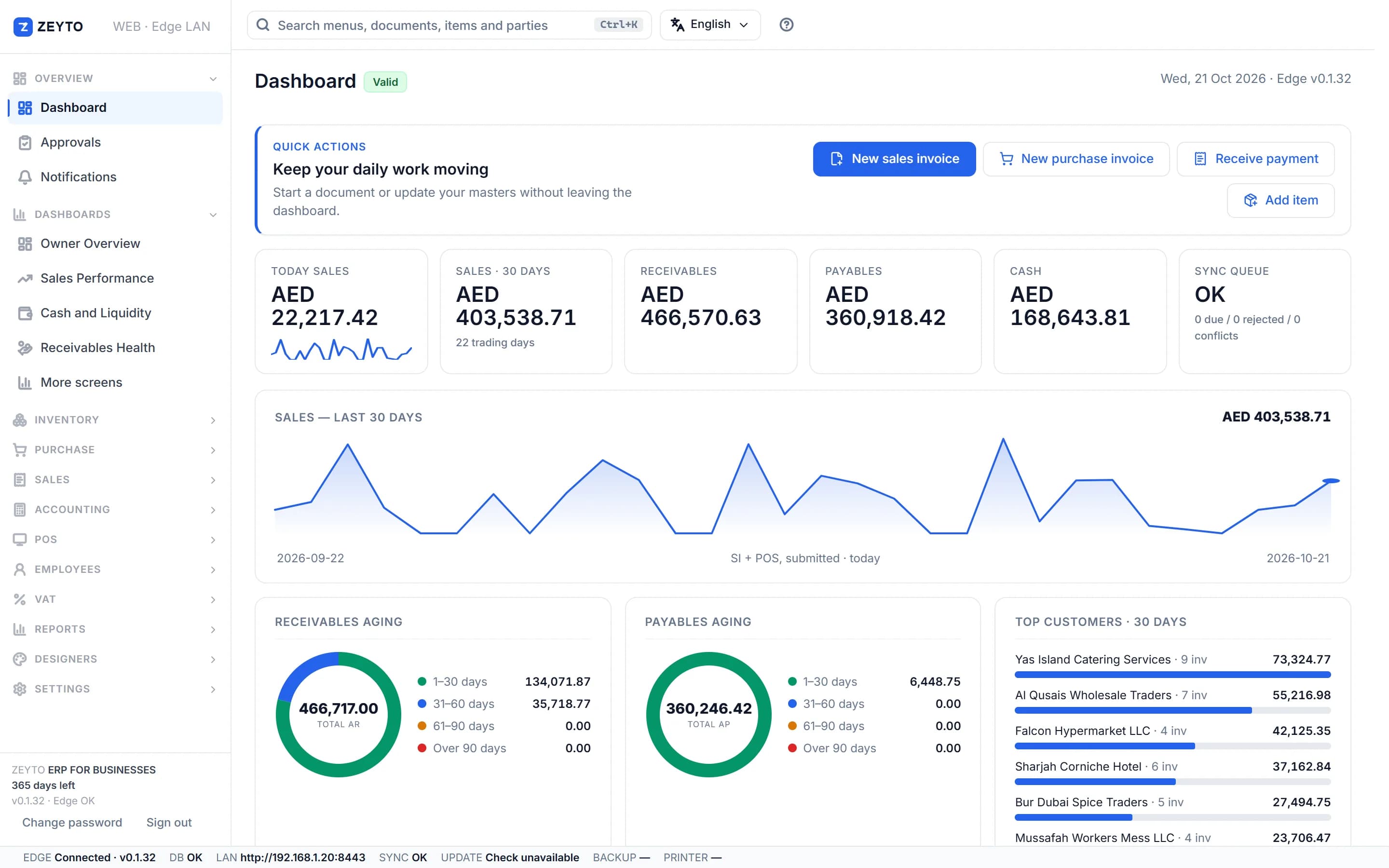
Screenshot from the Zeyto demo company, with sample data.
The bill
A progress bill goes through five steps, each with its own status.
Worked example
Contract value AED 1,000,000, retention 10%, advance 10%, VAT 5%.
Retention
Retention is the part of each certified amount the client keeps until the work is accepted and defects are fixed. In Zeyto Construction & Contracting it is held as a receivable in an append-only retention ledger, so the balance can always be traced to the bills that created it and the releases that cleared it. The invoice charges VAT only on the part billed; the retention is a negative line and its VAT is declared on the release.
If the contract has a cap, retention stops when the total held reaches that share of the contract value. With a contract of AED 5,000,000 and a cap of 5%, the most that can be held is AED 250,000. To release, you record a practical completion certificate, request a release (by default 50% of the retention held at practical completion, and the whole balance at the end of the defects period), and two different people, neither the one who requested it, approve it before the release invoice is issued. With AED 100,000 held, a practical completion release is 50,000 plus VAT 2,500, an invoice of 52,500.
UAE VAT
Construction services supplied in the UAE are standard-rated at 5%, whatever the building. Zero-rating of the first supply of a residential building applies to the sale of the building, not to the contractor's construction services (FTA real estate guide). A tax invoice must be issued within 14 days of the date of supply, and for construction contracts with periodic payments the date of supply is generally the earliest of the invoice, the due date on the invoice and receipt of payment; certification alone does not create it.
The FTA's real estate guide treats retention under the rules for continuous supplies of services: the supply date is the earliest of the retention being paid, a tax invoice being issued for it, or 12 months after the work was signed off as complete. If a retention stays unreleased for more than 12 months after sign-off, the VAT can be brought forward even without a release. Diary the 12-month date for every project and ask your tax adviser how to treat it, because the system does not raise it for you. An advance is a tax invoice on the day the money is received, with VAT as 5/105 of the gross, and each bill reverses the VAT already declared pro rata.
Reverse charge is not for ordinary construction work There is no domestic reverse charge for construction work. Reverse charge applies to imported goods and services, so a foreign design or specialist service bought from outside the UAE may fall under it. For UAE e-invoicing, Zeyto's connection to an Accredited Service Provider is not released yet, so we do not claim e-invoicing readiness. This page is general information, not tax or legal advice, and was last reviewed on 8 November 2026.
Go deeper
Lessons in the Zeyto Academy.
Next step
Open the public demo, install the Windows trial, or talk to the Zeyto team about your workflow.
No install needed
Demo data refreshes nightly to keep the sample company clean.
Open live demoYour own PC
Run Zeyto cloud, private cloud, on-premise or on a local server, with desktop shell, browser access and the mobile app.
Sales, support, partners
Send your industry, branch count, users and reporting needs. We route you to the right person.
FAQ
Open the demo, or look at Zeyto Construction & Contracting.